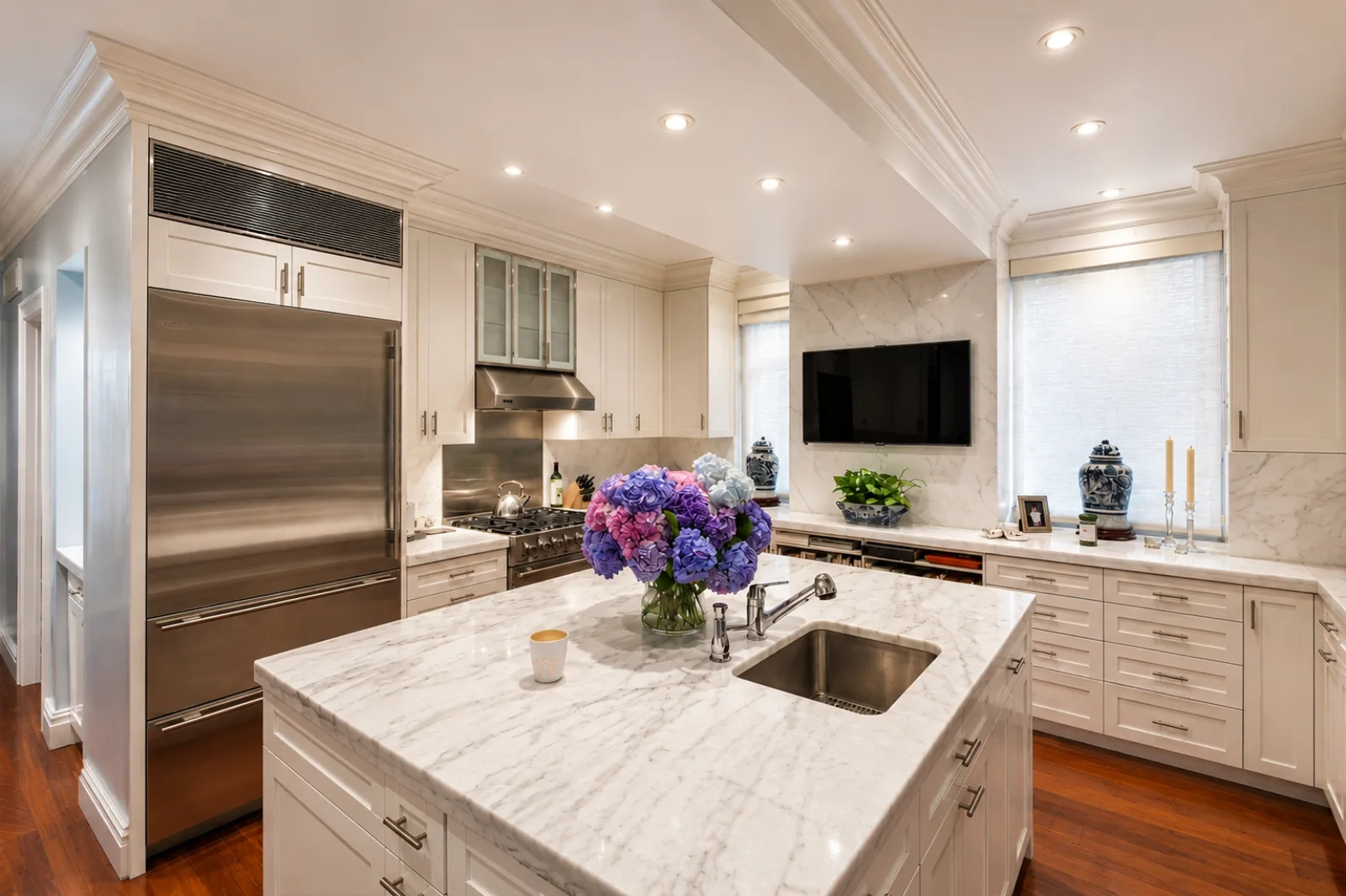
No selection changes a kitchen's character, or its budget, quite like the counters. It is the surface you touch every day and the first thing eyes find in a renovated space. The right choice starts with an honest question: do you want a surface that stays perfect, or one that lives and ages with you? Answer that, and the material menu below sorts itself quickly.
Marble: The Beauty With Terms and Conditions
Calacatta and Carrara remain the defining stones of the luxury New York kitchen for a reason: depth, movement, and light no manufactured surface fully matches. The terms: marble is soft and chemically reactive, so lemon juice and wine etch it, leaving dull marks, and it wants periodic sealing against stains. A honed finish hides etching far better than polished. Owners who see patina as character adore it for decades; owners who will chase every mark should borrow marble's look elsewhere. Marble also makes a spectacular full-height backsplash, a move we explore in our luxury kitchen guide.
Quartzite: Natural Drama, Serious Durability
Quartzite, the natural stone, delivers marble-adjacent veining with far greater hardness and acid resistance. Slabs such as Taj Mahal and Mont Blanc carry real movement and take honed or leathered finishes beautifully. It costs more than most granite and much engineered stone, and it still appreciates sealing, but for owners who want natural stone without marble's temperament, quartzite is usually the answer. On dramatic islands and waterfall ends it is currently the signature stone of high-end NYC work.

Engineered Quartz: The Worry-Free Workhorse
Engineered quartz, stone particles bound in resin, is the most popular counter in America on merit: nonporous, stain resistant, never needs sealing, and consistent from sample to slab. Marble-look patterns have become remarkably convincing. Its limits are heat, since the resin can scorch under a hot pan, and a certain perfection that reads manufactured up close. For hard-working family kitchens and rentals, and for anyone who wants zero maintenance conversation, it is the rational pick.
Granite, Porcelain, and the Specialists
- Granite has cycled out of fashion and back into respect: enormously durable, heat tolerant, and handsome in current honed and leathered finishes. Absolute black granite, leathered, is a quiet luxury move on pantry and bar runs.
- Porcelain slab brings large formats, thin profiles, and printed veining that tolerates heat and UV. Edges reveal the print on some patterns, and fabrication demands a specialist, but for crisp modern kitchens it earns its place.
- Butcher block and stainless serve beautifully as accents: wood warming an island's prep zone, stainless flanking a serious range.
The Details That Move the Price
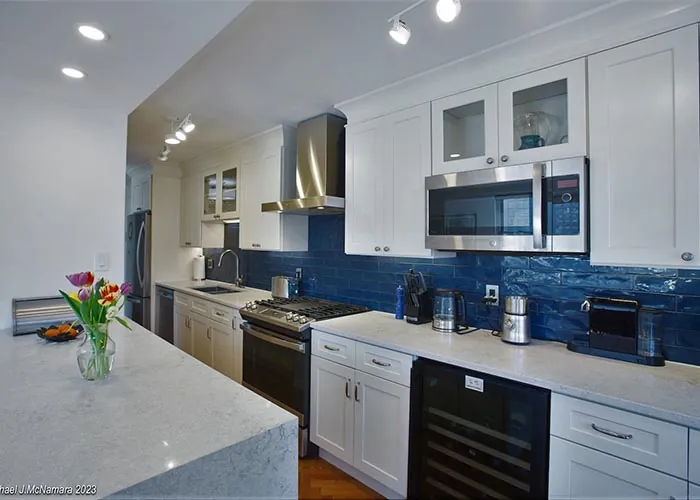
Two identical materials can produce very different invoices. The drivers: slab grade and rarity, mitered edge buildups that make a counter read thick, waterfall ends, full-height slab backsplashes, book-matching across an island, the number of cutouts, and seam strategy. As a working band, stone packages on our projects run roughly $3,000 to $12,000 and up within the broader budget covered in our kitchen cost guide. In apartments there is also the New York question: what fits in the elevator. Experienced fabricators template after cabinets are set and plan pieces around the building's actual geometry.
Choosing Well: A Short Method
Decide maintenance temperament first, perfect versus patina. Shortlist two or three materials, then go see full slabs at the yard rather than chips in a binder, because veining is a composition you are buying by the square foot. Bring your cabinet door and flooring samples. Then let your designer sequence the decision before construction, since counters gate the template, the plumbing trim, and the backsplash that follows them, as our timeline guide lays out.
How Knockout Renovation Handles Stone
Our Designer Project Managers take clients from material temperament to the slab yard to a fixed price that includes fabrication reality, no allowance surprises. We coordinate templating, seams, and building logistics, and the installed work is covered by our 7-year warranty. If you are torn between two stones, bring us photographs of how your kitchen actually gets used on a Tuesday night, and we will tell you which one you will still love in ten years.
Frequently Asked Questions
What is the best countertop material for an NYC kitchen?
There is no single best, only best-for-you. Engineered quartz wins on worry-free daily life, quartzite delivers natural stone drama with real durability, marble offers unmatched beauty for owners who accept patina, granite remains a durable workhorse, and porcelain slabs excel in thin modern profiles. Decide how you cook and clean first, then pick the material.
Is marble a mistake in a kitchen?
Not a mistake, a relationship. Marble etches when acids touch it and can stain without sealing, and honed finishes soften the evidence. Owners who love the living surface never regret it; owners who want the counter to look like installation day forever should choose quartzite or quartz with a marble look.
What does stone fabrication and installation cost in NYC?
As a working range, stone countertop packages on our projects typically run $3,000 to $12,000 or more, driven less by the slab than by fabrication details: mitered edges, waterfall ends, full-height backsplashes, cutout counts, and book-matching. Exotic slabs and large islands push past the top of the range.
Quartz vs. quartzite: what is the difference?
Quartzite is a natural metamorphic stone, quarried in slabs, very hard, with genuine one-of-a-kind veining. Engineered quartz is a manufactured surface of stone particles in resin, extremely consistent and stain resistant, but its resin limits heat tolerance. The similar names cause endless confusion at showrooms; ask which one is on the label.
How are slabs handled in NYC apartment buildings?
Templating happens after cabinets are set, then slabs are cut and delivered as pieces sized for your building's elevator, hallways, and turns. Long islands sometimes dictate a seam placement decision or, in townhouses, hoisting. An experienced fabricator scopes the route before the stone is cut, not after.